
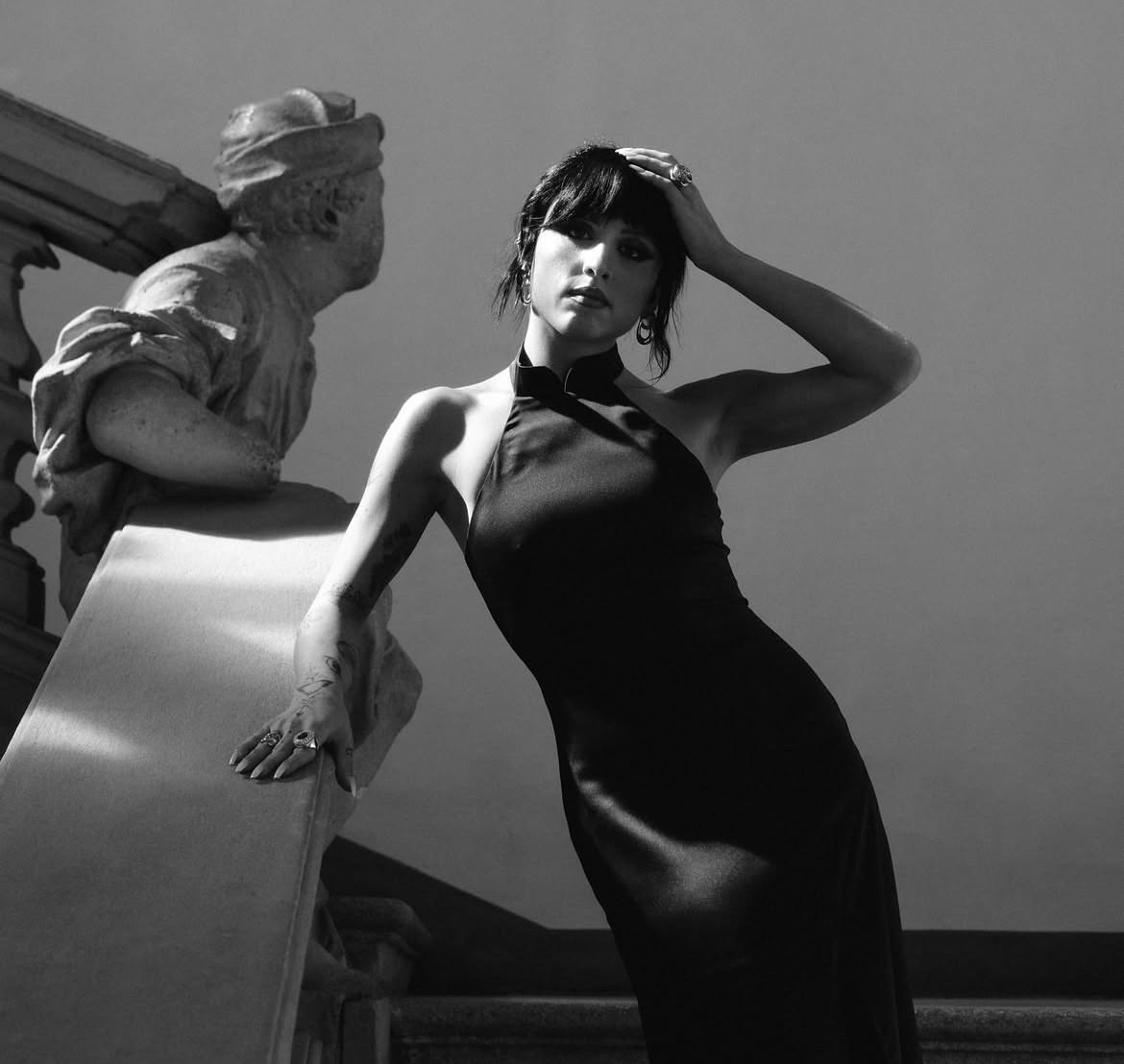
Two songs, two different moments in life, one common thread: the fear of growing up and the courage to accept who we are.

Listening closely to Angelina Mango’s “Tutto all’aria” (Everything Upside Down) and “Vita di adulti” (Adult Life), a profound connection begins to emerge, almost as if the two songs were different chapters of the same story.
We don’t know whether Angelina intentionally created a narrative connection between these songs, but the images, words, and emotions running through them seem to speak to one another.
On one side, we find a girl who feels unprepared to face life. On the other, a young woman who is beginning to accept it, with all its contradictions.
It is the story of growing up — a process that doesn’t happen overnight, but unfolds through doubts, changes, vulnerability, and new awareness.
“Tutto all’aria”: The Fear of Growing Up
In “Tutto all’aria,” Angelina describes a changing life, a love that turns everything upside down, and the struggle to face the responsibilities of adulthood.
At the beginning of the song, a fundamental idea emerges: it’s time to grow up.
There is a house to put in order, responsibilities to face, and matters that seem more important than love.
It’s almost as if adult life is beginning to demand its own space, forcing the protagonist to leave behind the spontaneity of youth.
But growing older doesn’t necessarily mean feeling ready.
Angelina describes how she has changed, how she no longer entirely recognizes the person she was just the day before, yet emotionally she still carries the same innocence.
It is a deeply human contradiction: time makes us grow older, but our hearts don’t always grow at the same pace.
One of the most meaningful moments comes toward the end of the song, when she expresses a simple but powerful desire: she wants to live.
Yet she admits that she doesn’t know the rules of this game called life.
And that is precisely what makes the song so meaningful.
The protagonist wants to experience the world, to love, to make choices, to make mistakes, but she doesn’t yet have the tools to understand everything happening around her.
Love, moreover, becomes something unpredictable: a feeling capable of shaking every certainty and destroying what once seemed solid.
And when something breaks, you have to pick up the pieces.
It’s not a game.
It’s life.
“Vita di adulti”: Learning to Accept Growing Up
In “Vita di adulti,” we seem to meet the same girl again, but with a different kind of awareness.
She isn’t necessarily someone who has found all the answers.
She is someone who is beginning to understand that perhaps having all the answers isn’t essential.
Adult life is not portrayed as a final achievement, but as a condition filled with conflicting emotions.
There is hair growing longer, a new home, small everyday gestures, and even a basil plant that keeps dying.
These are simple, almost ordinary images, yet they become metaphors for something much greater.
Everyday life has entered the protagonist’s world, bringing new responsibilities and a sensitivity that seems to grow stronger.
Everything moves her.
And perhaps that is the most important change: she no longer feels the need to resist every emotion she experiences.
In “Tutto all’aria,” life seems like something slipping beyond her control.
In “Vita di adulti,” however, Angelina seems to begin accepting that not everything can be controlled.
Growing up doesn’t mean becoming less vulnerable.
It means learning how to live with that vulnerability.
The Invisible Thread Connecting the Two Songs
There are several particularly interesting connections between these two songs.
1. Growing Up and Living an Adult Life
In “Tutto all’aria,” growing up appears as a necessity, almost an obligation imposed by life.
In “Vita di adulti,” that same condition is viewed from a different perspective.
The protagonist no longer seems simply frightened by growing older.
She is beginning to discover that there might even be something beautiful about this new stage of life.
It’s almost as if the second song answers the first.
At first, there was the fear of growing up.
Now, there is an attempt to accept everything that comes with it.
2. The House That Needs Fixing and the New Home
This is perhaps one of the most interesting symbolic connections.
In “Tutto all’aria,” there is an image of a house that needs to be put in order.
The house may literally represent everyday responsibilities, but metaphorically, it can also represent life itself.
There is something to organize.
Something to rebuild.
Something that needs to find its place.
In “Vita di adulti,” however, we encounter a new home.
The protagonist is now living inside a different reality, yet she still feels suspended, almost as though she hasn’t completely found her place within it.
It’s almost as if, in the first song, she still needs to build her life, while in the second, she finally finds herself inside that life without quite knowing how to inhabit it.
The house becomes a symbol of transformation.
Having a place to live doesn’t automatically mean feeling at home, just as becoming an adult doesn’t necessarily mean feeling grown up.
3. Love That Breaks Everything and Love That Helps Us Carry On
In “Tutto all’aria,” love appears as a force capable of destabilizing every certainty.
The protagonist allows herself to become completely involved, to the point of emotionally risking everything she has.
When the relationship begins to fall apart, the world she imagined seems to collapse around her.
In “Vita di adulti,” however, love takes on a different meaning.
It is no longer simply something that can turn life upside down.
It also becomes the desire to share the challenges of growing up with someone.
It’s a subtle but important difference.
In the first song, love seems to have the power to destroy emotional stability.
In the second, it may represent the possibility of finding stability through togetherness.
4. Not Knowing the Rules and Accepting Life’s Contradictions
In “Tutto all’aria,” Angelina expresses the desire to live without knowing exactly how to face what lies ahead.
It is the fear of confronting something bigger than yourself.
In “Vita di adulti,” that uncertainty doesn’t seem to have disappeared.
The protagonist continues questioning life, emotions, and what it means to have become a woman.
But her attitude seems different.
She doesn’t necessarily need an explanation for everything anymore.
She is beginning to recognize that life is also made of incomprehensible situations, unexpected emotions, and small everyday failures.
Even a dying basil plant can become a symbol of how difficult it sometimes is to manage responsibilities.
And it is precisely this imperfection that makes the story feel so authentic.
Two Versions of the Same Angelina
If we imagine these two songs as parts of a single journey, something fascinating emerges: an almost imaginary conversation between two versions of the same person.
The Angelina of “Tutto all’aria” seems to be saying:
I want to live, but I still don’t know how.
The Angelina of “Vita di adulti” might answer:
I still don’t know exactly how, but maybe I’m starting to like this life.
After all, becoming an adult doesn’t necessarily mean learning how to control everything.
It means finding the courage to live even when you don’t have all the answers.
It means accepting that some things will fall apart, that certain feelings will change, and that sometimes starting over is unavoidable.
It means understanding that vulnerability and maturity are not opposites.
We can be adults and still feel afraid.
We can build a home and still feel lost.
We can love deeply without knowing how to protect what we love.
And we can be moved by the simplest things, precisely because we have learned to recognize their value.
But Who Is the “You” in “Vita di adulti” Really Addressed To?
There is one more possible interpretation worth exploring.
In “Vita di adulti,” the desire to share adult life with someone could certainly be understood as a declaration of romantic love.
But are we sure that the person being addressed is necessarily a romantic partner?
What if that “you” also represents someone who is no longer here?
Knowing Angelina’s personal story, marked by the loss of her father, Pino Mango, when she was only thirteen years old, this question takes on a particularly emotional meaning.
Of course, we cannot claim that the song is dedicated to him.
That would mean attributing an intention to Angelina that she has not necessarily expressed.
However, from an emotional perspective, this interpretation opens up an interesting possibility.
When you lose someone essential during childhood, growing up also means learning to experience all those moments you wish you could have shared with them.
A new home.
Your first real responsibilities.
The struggles of everyday life.
The moment you suddenly realize that you are no longer a child.
These milestones can make someone’s absence feel even more powerful.
And so, the desire to experience adult life alongside another person might also carry a deeper sense of longing: the wish to have someone important beside you throughout your journey of growing up.
It is a possible interpretation, not a certainty, but it fits within the emotional sensitivity that runs through many of Angelina’s songs.
Conclusion: Growing Up Doesn’t Mean Leaving Your Inner Child Behind
Perhaps the deepest connection between “Tutto all’aria” and “Vita di adulti” isn’t simply about love, homes, or responsibilities.
It’s about the relationship we have with ourselves as we grow older.
In “Tutto all’aria,” we seem to encounter a girl desperately trying to understand the rules of life.
In “Vita di adulti,” we find a woman beginning to accept that those rules are not always clear.
The first is afraid that everything might fall apart.
The second seems to have understood that even the broken pieces somehow belong to our story.
And perhaps this is the beauty of Angelina Mango’s songwriting: her ability to express complex emotions through simple, everyday images in which anyone can recognize themselves.
A house that needs fixing.
A new home.
A love that turns everything upside down.
A plant that keeps dying.
The desire to live.
The fear of growing up.
Two songs that seem to tell one profound truth: becoming an adult doesn’t mean becoming less vulnerable. It means learning to love life even through our own vulnerabilities.
And perhaps, in the end, growing up means exactly that:
Accepting that somewhere inside the woman we have become, the little girl we once were is still alive.


