
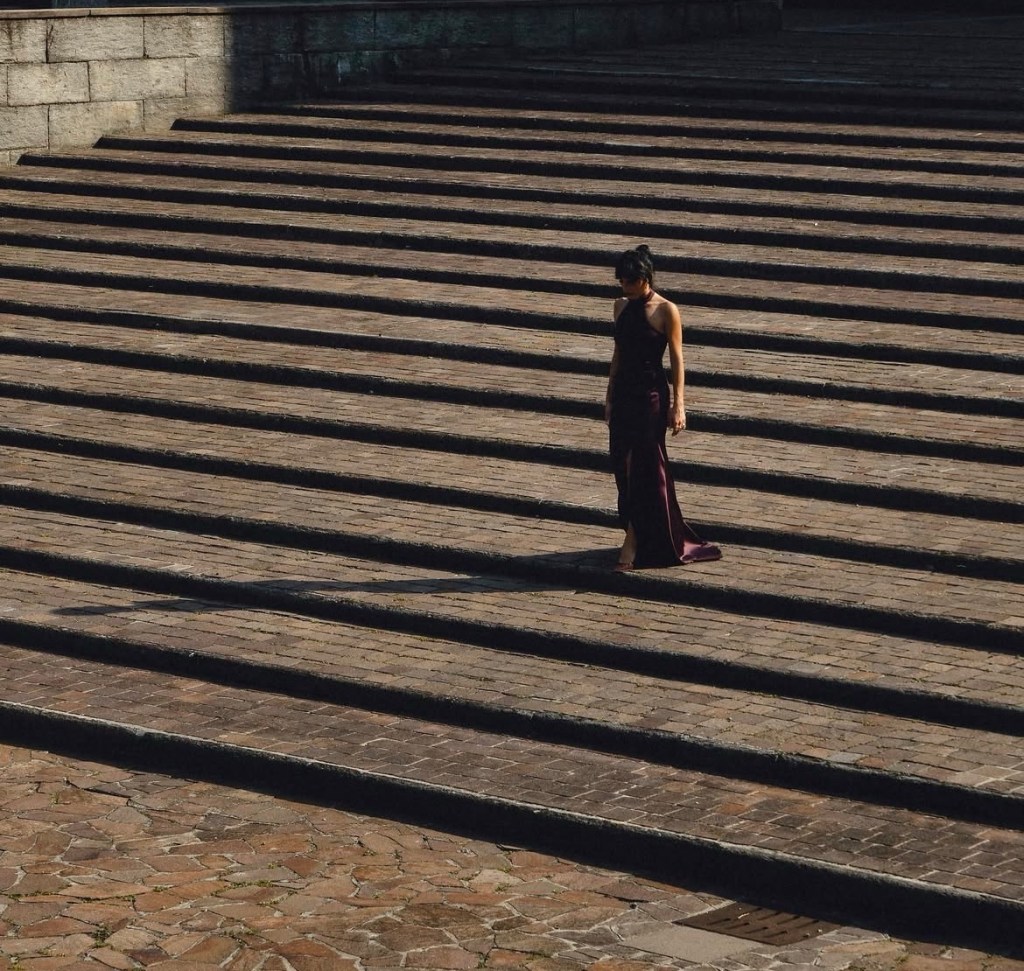
The fear of growing up, the need to feel loved, and the search for a safe place. In “Vita da adulti” (Adult Life), Angelina Mango explores the transition into a new chapter of life through everyday images, vulnerability, and disarming sensitivity.
Some songs tell a story, while others seem to open the doors to someone’s life. Angelina Mango’s “Vita da adulti” belongs to the latter.
After the profound introspection of Caramé, Angelina seems to be stepping into a new dimension: that of a woman learning to live with her emotions, her responsibilities, and the fear of losing what she loves.
But does becoming an adult really mean knowing how life works?
Turning on the Lights: Learning to Understand Yourself
The song opens with a seemingly simple image: turning on the lights in an attempt to understand.
It is a beautiful metaphor for self-awareness. Before facing the world, we must learn to look within ourselves, understand who we are, and accept our contradictions.
Angelina wonders how to avoid losing herself, how to like herself, and how to stand out.
Three questions that capture an essential part of growing up: not losing your identity while trying to find your place in the world.
And perhaps this is one of the greatest challenges of adulthood: continuing to recognize yourself, even when everything around you changes.
The Frames: The Desire to Be Seen
Among the song’s most delicate images are the drawings, the paintings, and the picture frames.
A drawing can exist without a frame, but framing it means giving it value, choosing to preserve it and put it on display.
The paintings waiting on the floor thus seem to become a metaphor for the parts of ourselves that long to be recognized.
Not necessarily by the entire world. Sometimes, all we need is one person capable of seeing what we struggle to appreciate in ourselves.
Being loved also means feeling seen and accepted in all our imperfections.
A Safe Place: A Question That Becomes a Certainty
At the beginning, Angelina questions the safety of home, almost doubting whether a place capable of truly protecting us even exists.
Later, however, the same image takes on a different meaning.
Physical closeness, shared silence, and resting one’s forehead against another person’s become representations of emotional security.
No grand declarations are needed.
Home is no longer simply a place made of walls and rooms. It becomes a relationship, a presence, a space where we can finally let our guard down.
And yet, one question remains: how safe can a place really be if we are afraid of losing it?
Crying Like Little Creatures: The Freedom to Be Vulnerable
One of the most powerful moments in the song is when Angelina invites us to leave grown-up conversations behind and return to crying like little creatures.
The choice of the Neapolitan word criature is particularly meaningful.
It does not simply refer to childhood. It evokes innocence, spontaneity, and vulnerability.
As children, we do not necessarily need to justify every emotion. We cry, we laugh, we fall apart, and moments later, we go back to living.
As adults, however, we often feel the need to control everything, even what we feel.
Angelina seems to remind us that growing up does not mean giving up the most spontaneous part of ourselves.
We can become adults without losing the ability to be amazed, to feel deeply, or to cry for no particular reason.
Hair and Flocks of Birds: The Freedom to Change
Then there is the image of long hair moving together with flocks of birds.
Her hair becomes a possible symbol of transformation, of time passing, and of a femininity that is evolving.
The flocks of birds, meanwhile, evoke movement, freedom, and the need to follow a direction, even without knowing exactly where it will lead.
It is almost as if Angelina were observing herself from the outside, surprised by the person she is becoming.
And in the middle of this transformation lies a fascinating paradox: finding a reason even when there apparently is none.
Perhaps this is precisely what growing up means: learning to find meaning even in things we cannot fully explain.
The New Home and the Basil Plant: The Fragility of Everyday Life
One of the most poetic details is the basil plant that keeps dying.
Such a small, almost ordinary image, yet one that carries a much deeper meaning.
Basil is a domestic plant, something we are supposed to care for. It requires attention, consistency, and balance.
And yet, it can die despite our best intentions.
It therefore becomes a possible symbol of the small responsibilities of adulthood, of the things we try to keep alive but cannot always protect.
Alongside this detail appears a new home, where Angelina feels suspended, almost caught between different stages of life.
The house represents a new chapter of existence, but also the disorientation that accompanies every change.
You can have a new home and still not feel completely at home. You can become an adult and still be searching for your balance.
And above all, you can be happy and frightened at the same time.
Love Should Never Become Just a Habit
In the second part of the song, an even more mature reflection emerges: the fear that a relationship might lose its authenticity.
Angelina seems willing to accept even a separation if staying together would mean hurting each other.
It is a form of love that does not seek possession at any cost.
There is also an awareness that routine can turn a love story into something empty, into pages filled without having anything meaningful left to tell.
But there is another possibility: living a story so authentic that there is no need to invent it.
The imagery of drawing returns, this time through the body and its contours.
As if loving someone meant learning every detail of them, until you could recognize and describe them even with your eyes closed.
It is an intimacy built on deep understanding, not merely desire.
The Frame Returns: Holding on to a Moment
Towards the end, the picture frame reappears, but its meaning seems to have changed.
At first, it held drawings waiting to be noticed. Now, it seems to hold a person, a moment, something that she does not want to lose.
Angelina does not demand to know the future, nor does she want to anticipate what will happen.
Instead, she chooses to live in the present, even when it is messy, imperfect, and uncertain.
The frame thus becomes a poetic attempt to freeze a moment without being able to stop time.
We cannot control how long happiness will last, but we can recognize it while we are living it.
“Vita da adulti”: The Beauty of Growing Together
The heart of the song, in my interpretation, lies in the contrast between the desire to become an adult and the desire to remain a childlike creature.
On one side, there are responsibilities, a home to live in, relationships to build, plants to care for, and fears to face.
On the other, there is the need to keep laughing, crying, making mistakes, and being surprised by life.
Angelina does not offer a definitive answer to what it means to grow up.
Instead, she seems to tell us that maturity is not about having everything under control, but about accepting that we cannot control everything.
And love does not erase that uncertainty, but it can make it less frightening.
From Caramé to Vita da adulti: A New Chapter
Listening to Vita da adulti after Caramé, it is difficult not to feel an emotional connection between the two.
If Caramé took us through pain, memory, loss, and the search for identity, this new song seems to open a window onto the present.
It does not mean that every wound has healed or that every question has finally found an answer.
Perhaps it means something even more important: being ready to live without having all the answers.
Angelina’s songwriting continues to find poetry in seemingly insignificant details: a dying plant, a drawing waiting to be framed, a messy home, hair moving in the wind.
These fragments of everyday life become universal because, deep down, they belong to all of us.
And perhaps Vita da adulti leaves us with this very thought:
Growing up does not mean becoming less vulnerable. It means learning to live with our vulnerability, while finding someone with whom we are no longer afraid to show it.
Because sometimes adult life does not become easier.
It simply becomes more beautiful when we have someone to share it with
Song
English translation of first lyric:
Still have to turn on the lights and then understand what you’re saying
When you try to love me
When you start talking to me before falling asleep
And put frames around my drawings
You would hang up the paintings looking for attention
That are waiting on the floor to be noticed
And I remain silent, rushing myself to get back home
A safe place, but when is it safe?
Let’s leave grown-up conversations behind
And cry like little creatures, for no reason
Just to say: ‘What life is this?’”
Listen to a song


